I spent a morning last week at The National Gallery in London thinking of Patti Smith’s first time in a museum. In ‘Bread of Angels’, she talks about the life-changing day her father decided to take their family to the Philadelphia Museum of Art, describing it as “a revelation”. They had no money to go even to a restaurant or the movies together, but thanks to a family discount day, they managed to get access to a full, precious day at the museum. She wandered off on her own, escaping from her father’s preferred Dalí’s into a hall of Picasso’s, where she had an important realization:
“I was smitten with Picasso and for the first time I realized my father and I had strong conflicting ideas, and I had no qualms about defending my point of view. I now felt I had superlative allies, who would one day lead me to a whole new world. I obediently followed my father out of the museum but held fast to an invisible transformation; I had fallen for art.”
As I walked through the Monet hall, I remembered my childhood obsession for the French painter, who had a similar effect on me as Picasso had on Patti. The year was 1997 and our teacher had given us an illustrated biography book ahead of a school trip to a Monet exhibition at the MASP museum in São Paulo. Six year old me was as impressed by his expressive brushstrokes as by his persistence to keep painting even as his sight deteriorated. After the school trip, my hyper-focus on Monet grew, and my mother encouraged me with more books about him and art supplies to make my own creations. While she has always been reluctant to call herself an artist, my mother undoubtedly is one. I grew up with her abstract paintings decorating the walls of our house; creations made with unusual natural elements she picked up on walks, like oddly shaped seeds, twisted branches and dried leaves. The only dolls I liked playing with were the manga-style princesses she drew on cardboard boxes, which we would cut out and use as models for foldable paper dresses she made for them. Even when playing with Lego, she used to make me laugh by attaching flowers to the Lego people’s heads instead of putting them on the garden like the box said. Growing up surrounded by books, art, and the playfulness to reimagine commonplace objects played an instrumental role in the person I grew to be. And as it turns out, thirty six year old me is still smitten with Monet. I walked around The National Gallery wide-eyed, feeling myself submerged in his water-lily ponds like a mermaid, collecting immaterial treasures within the depths of his garden.
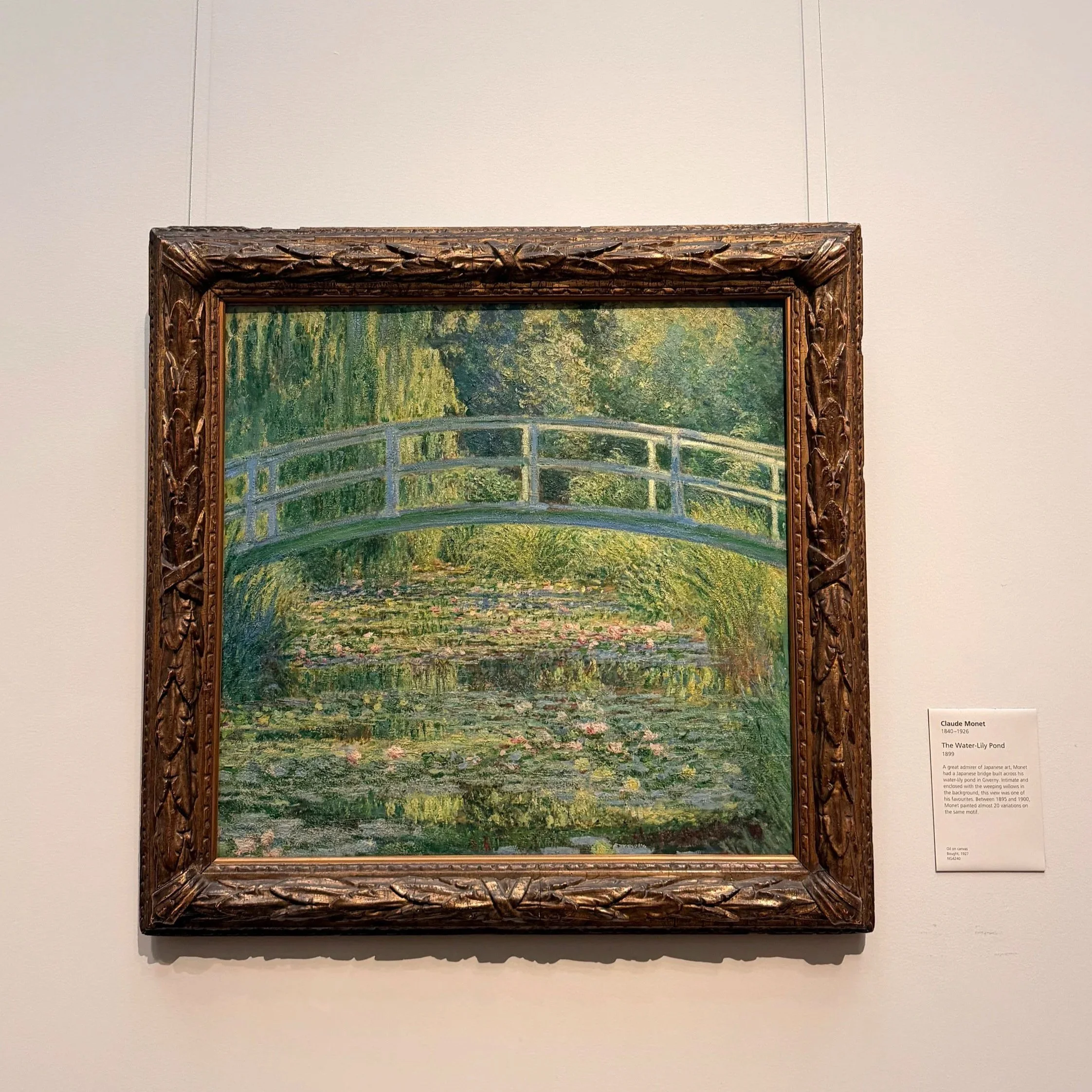
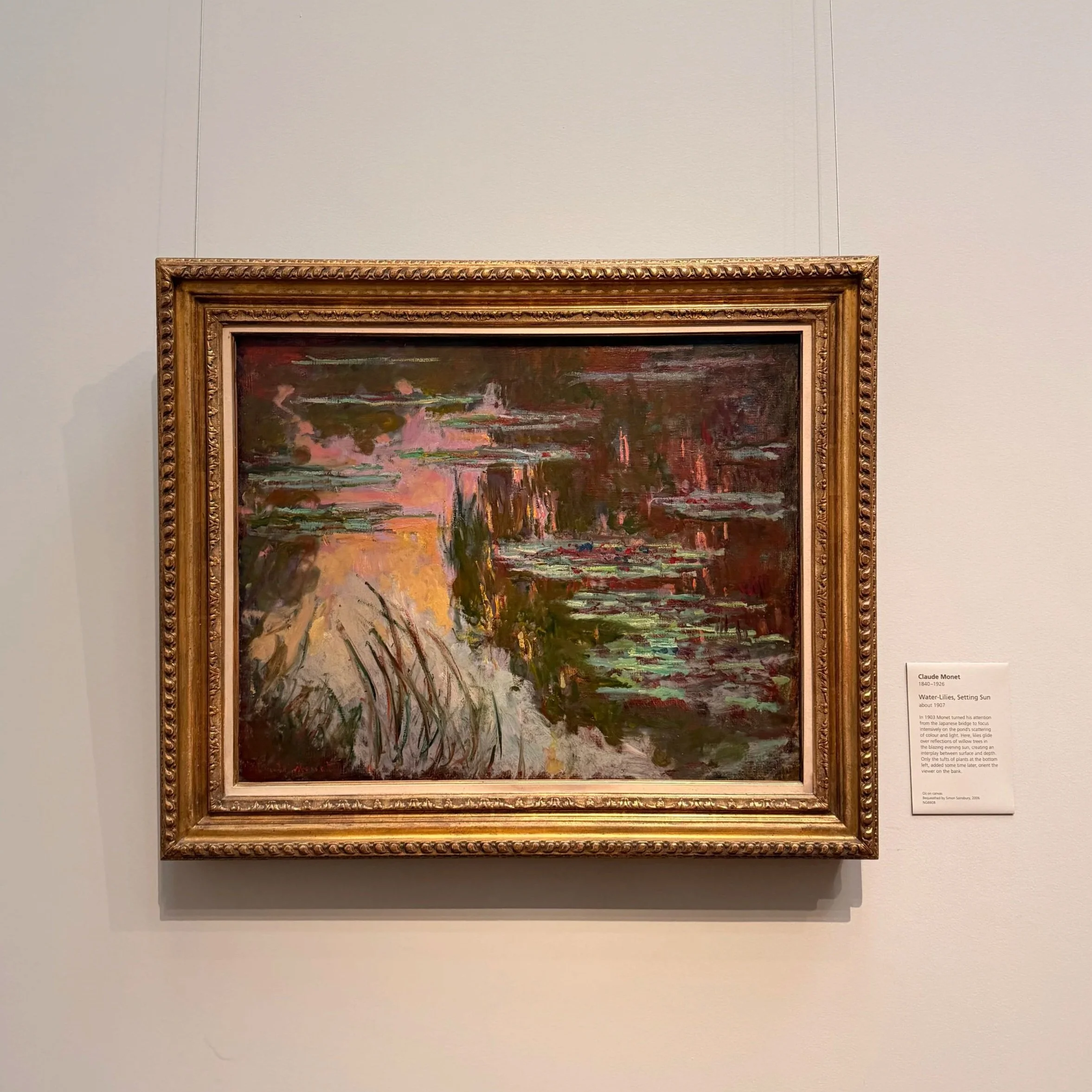
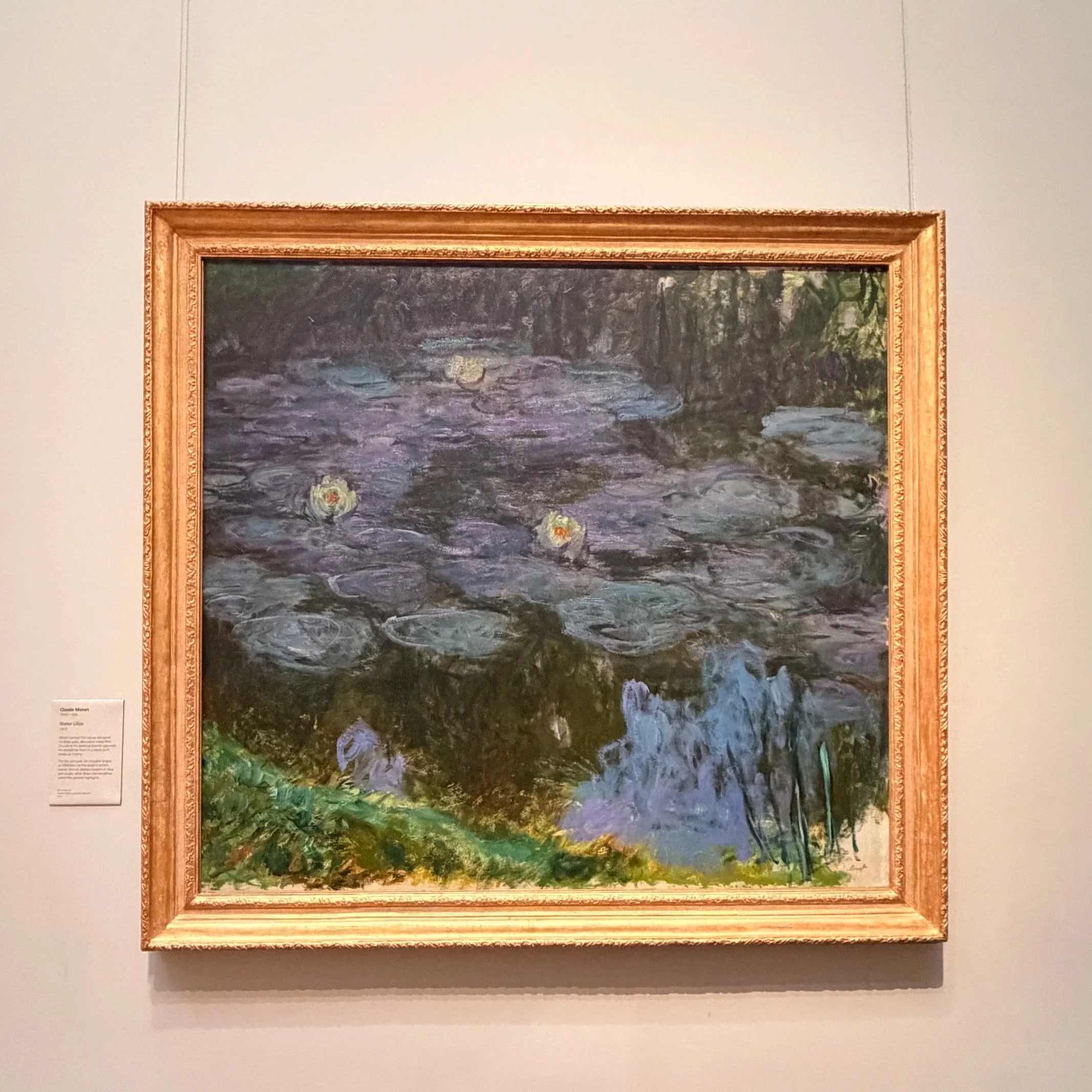
I slowly drifted toward the actual purpose of my visit. The white walls of Monet’s hall accentuating the color palette of his tranquil gardens were replaced by blood-red damask wallpaper and opulent gold frames with royal crests. Caged within one such frame was the painting that drew me there that morning: Paul Delaroche’s ‘The Execution of Lady Jane Grey’. I was grateful for the wooden bench positioned precisely in front of it, because this isn’t the kind of artwork you appreciate casually, as you walk on by. I took a seat, my eyes anchored to the young woman’s white underdress proclaiming her innocence, the white blindfold robbing her of her sight, and the whiteness of her bare skin clashing against the darkness around her. She is on her knees, and a man with gropey hands helps her feel for the wooden block placed right in front of her, where she is to lay her head on for her execution. His face is very close to hers, and every woman who has had unwanted advances by spattering men with beer-breath at a pub know exactly the discomfort it is to have some creep’s face as close as that. Towering over them to the right is another man, the executioner, casually leaning on his axe and looking bored out of his mind. To the left, her faithful ladies-in-waiting weep; one of them crumpled on the floor holding Lady Jane’s dress, the other with her back turned and face covered, too distressed to look.
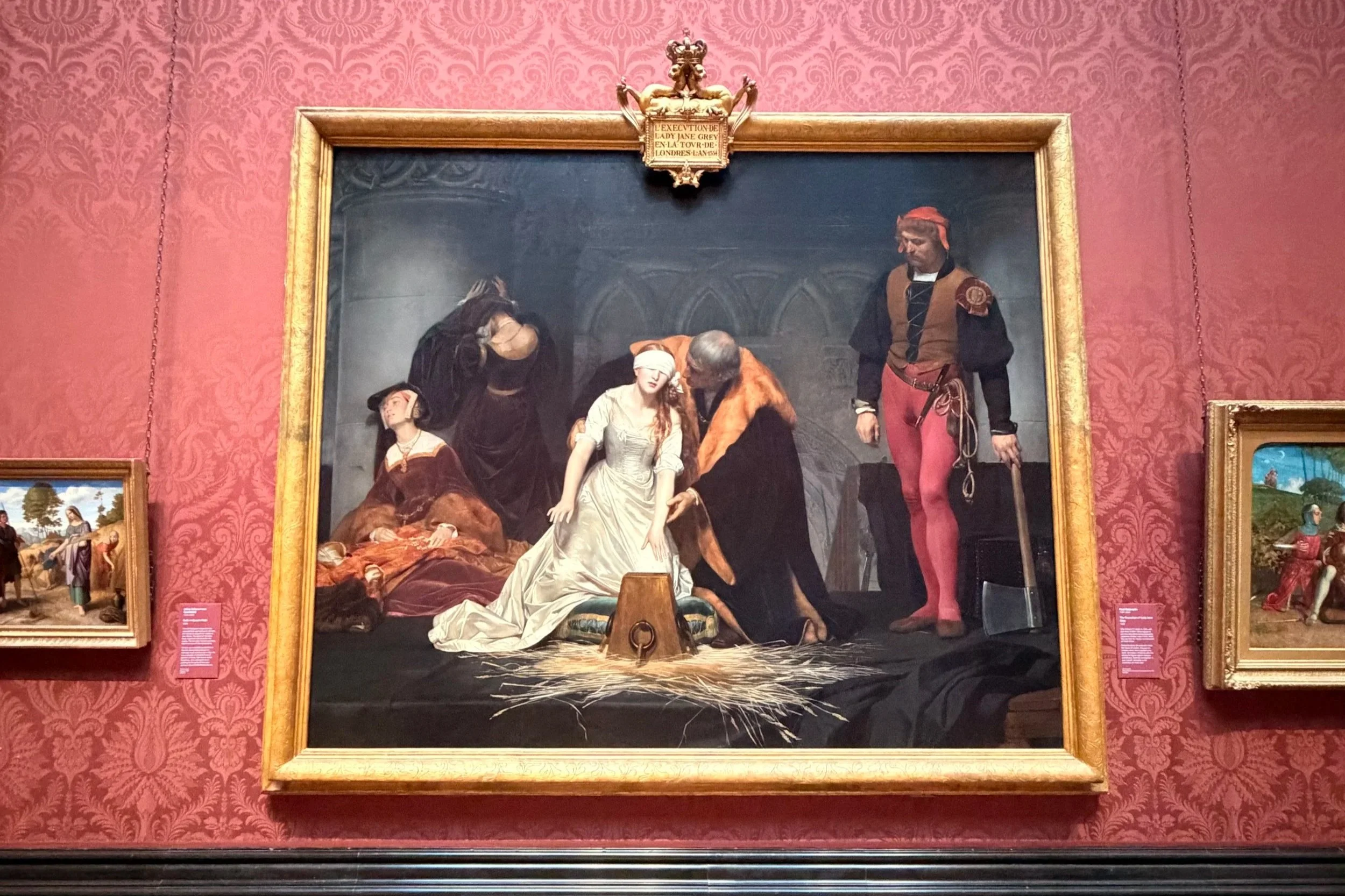
“This is the execution of Lady Jane Grey,” a woman’s voice shook me out of my trance, as she stationed herself next to me with her two kids. The youngest was a little girl no older than three, wearing her fine blonde hair in pigtails, wide-eyed as she clutched her mother’s hand tightly. Without softening her tone or speaking in that baby-voice adults sometimes use with kids, the mother continued looking straight ahead at the painting while telling her daughter, “She can’t see because she has a blindfold on, see? She is fumbling around for the wooden block, where she’s gonna have her head chopped off. See that man with the axe? He’s gonna do it. I think he actually used a sword, though.”
The girl was silent as her attentive eyes trailed the elements of the painting her mother had just mentioned. My focus was no longer on the painting, but on this woman’s approach to mothering her daughter. She didn’t talk down at her, neither did she shy away from the violence depicted in the scene. She talked to her like a person. A large painting of a horse further down the hall caught the attention of her little boy and they slowly began to move towards it. Discreetly, I followed them, curious to hear more. She explained to them that this one was by George Stubbs, and went on to describe his dedication to painting horses, while pulling out large notepads and crayons from her bag. Without a second of hesitation, she placed them on the floor and sat down cross-legged with her children in front of the painting, and began to draw. I watched them from a distance, feeling inexplicably moved.
As I left them, my mind went back to Lady Jane Grey. She was executed when she was only seventeen; a married woman at her time, but still a child by today’s standards. After doing some research, I discovered that she was fluent in over five languages and that, just like me, she was an avid reader, Plato being one of her favorites. At ten, she was sent away to be educated to Thomas Seymour, a family friend who also happened to be the uncle of the new king. Despite the fact that both the king and Jane were still children, Thomas saw Jane’s arrival as a profitable opportunity and immediately began his plans to marry her off and advance his own status. Around the same time, Thomas married Katherine Parr, the late King Henry VIII's widow. Katherine is painted by some historians as merely the king’s sixth and last wife and personal nurse, but she was actually an educated woman, a patron of the arts and music, a published author and an outspoken supporter of the English Reformation. Katherine oversaw Jane’s education and was a huge influence on her - sadly only for a short time, as she died in childbirth a year later. It was a time of a lot of political unrest, with a new king that was ill and too young to rule and a council of men fighting to have influence over him. Thomas was executed in these quarrels and a new leader, John Dudley, became the main advisor. As the king’s health deteriorated, he appointed Jane as heir simply because she was a Protestant, unlike his Catholic half-sisters Mary and Elizabeth. With his own ambitions in mind, John Dudley married Jane off to his son Guildford shortly before the king’s death. However, no one thought to actually tell Jane - so when the king died and the nobles started kneeling in front of her to pledge their allegiance, she was utterly confused, distressed and embarrassed. Later, at the crowning ceremony, she expressed her discomfort to wear the crown and refused to let her husband be made king without an Act of Parliament. She made her husband a duke instead, which infuriated her mother-in-law. In the meantime, Catholic Princess Mary raised an army of supporters of her own and managed to swing the London Council in her favor. Only 9 days after being crowned, Lady Jane was deposed - the shortest reign in British history, earning her the title “the nine day queen”. Her father-in-law was singled out as the scapegoat, and both Jane and her husband were arrested. Jane’s own parents abandoned her, rushing to pledge their allegiance to new Queen Mary, and Jane was left alone with her ladies-in-waiting in her Tower cell. Jane watched her husband being beheaded from her tower, and was privately executed an hour later. Queen Mary, who has her own complicated story, ended up not having a successful reign either, and Lady Jane was reclaimed much later as a Protestant martyr, hence the virginal white gown of innocence in Delaroche’s painting.
After reading Lady Jane Grey’s story, I finally understood why the scene with the mother and her kids at The National Gallery moved me so much. Despite her own mother’s abandonment in her final days, young Jane had Katherine Parr, whose tutelage probably prepared her later in life to be wary of wearing the crown. Days before her death, Jane supposedly said her father-in-law “hath brought me and our stock in most miserable calamity and misery by his exceeding ambition”, demonstrating her understanding of her dire situation and the havoc caused by the greedy men around her, who saw her as nothing but a pawn in their play for power. So to see a mother stand before Lady Jane, refusing to sugarcoat the brutality of what was done to her so that her young daughter can learn - is the most powerful historical reparation there is.
I recently read somewhere that “it’s not that women couldn’t earn a living back in the days; it’s that men removed their agency to do so” - and it’s so true. In a world where women (and all minoritized groups) were, and still are, systematically robbed of their agency, art is one of the gateways to access the energetic memories of those who came before us, and our keys to building a peaceable future. But every artwork also carries a perspective. Patti’s realization about her and her father’s dissent about Dalí and Picasso is also a lesson for how we consume it. We must consider who we are, what we believe in, and how we wish to inhabit this body we were gifted. In ‘Bread of Angels’, Patti describes her inquietude in Bible study when she is told “there was no place for art in Christ’s Kingdom” and “was counseled to consider what [she] truly believed in”. After giving it much thought, she decides:
“But I knew what I believed in. I believed in the Creator, the many tongues of nature, the moral lessons of fairy tales, the language of trees, and the clay of the Earth. I believed in the woolgatherers, soul-catchers, and monks who could leave their physical body and travel. I labored to form an equation that would include all things. (…) In the night, I searched for a solution; the atmosphere seemed to contain a sense of ancestral messaging. I considered those way back in time gazing at skies and forming constellations, pictures generated by human imagination. Perhaps those who had the eyes to see pictures were some of our first artists.”
So what triggers one to ‘see the pictures’ and become artists? Patti had her father, who unwittingly led her to Picasso. I had my school teachers, my mother, and Monet. The little girl at The National Gallery has her mother, Delaroche, and Lady Jane Grey. Our influences shape who we become and what we grow to believe in, but how we go on to live our lives is a decision that is purely ours - and one that requires our own rebel spark to be activated. Patti recognized hers in the fire that burned within when her father dismissed Picasso in favor of Dalí, or when the elders in her church told her there was no place for art in heaven. I recognize mine in the defining moments in my childhood when I had to choose between fitting in, or my passion for the peculiar - and the sense of wholeness I felt when I decided to stand by my unapologetically nerdy heart. And I hope that little girl at The National Gallery one day realizes the precious inheritance her mother is leaving her: a torch with her own rebel spark. One that isn’t afraid to look in the shadows and face the darkness head-on. One that isn’t compelled to sugarcoat, tone down, or flinch from the truth. Maybe one day that little girl will grow to be an artist, and she will paint Lady Jane Grey a new fate - one where she loses the blindfold, claims the man’s axe for herself, and goes in search of her rebel spark.
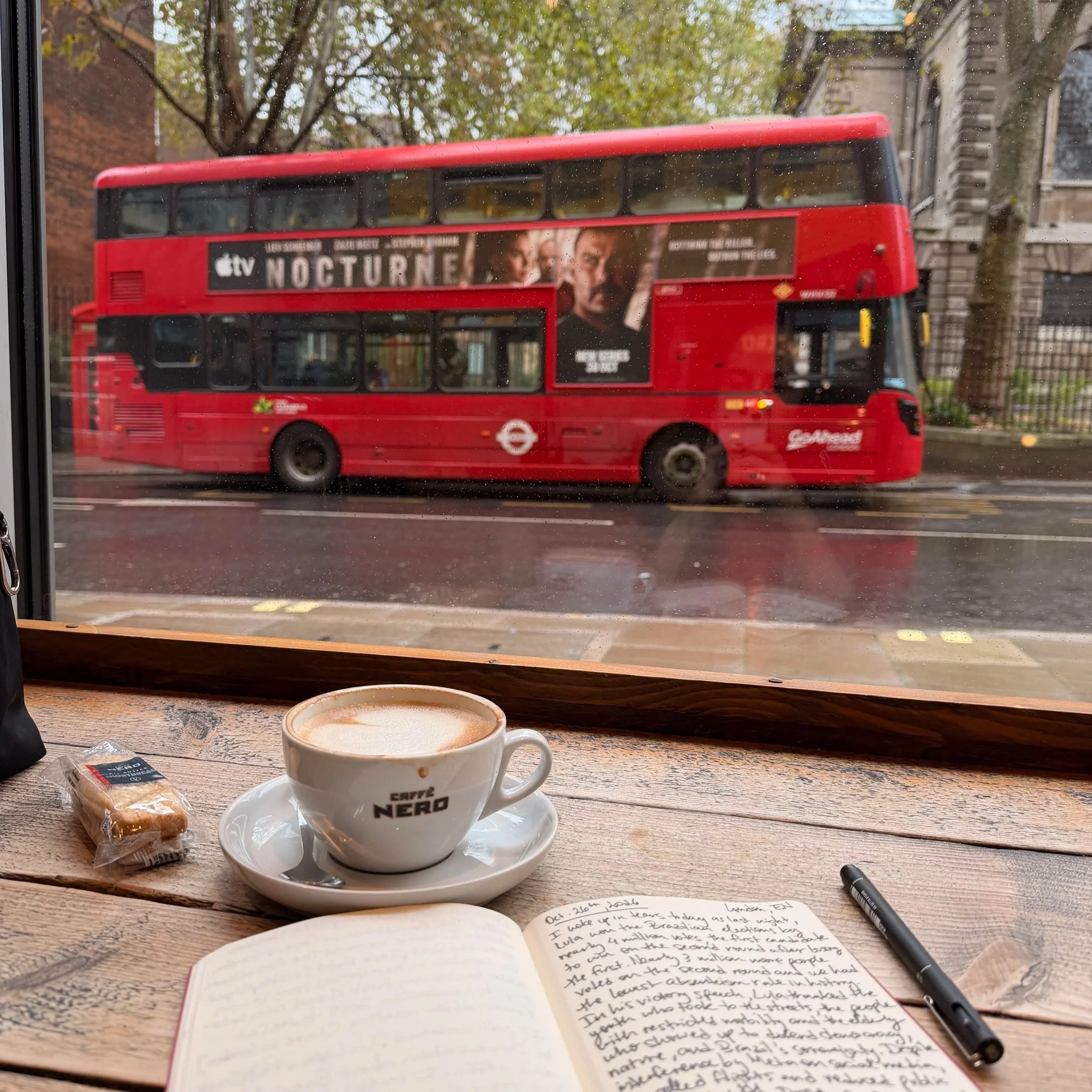
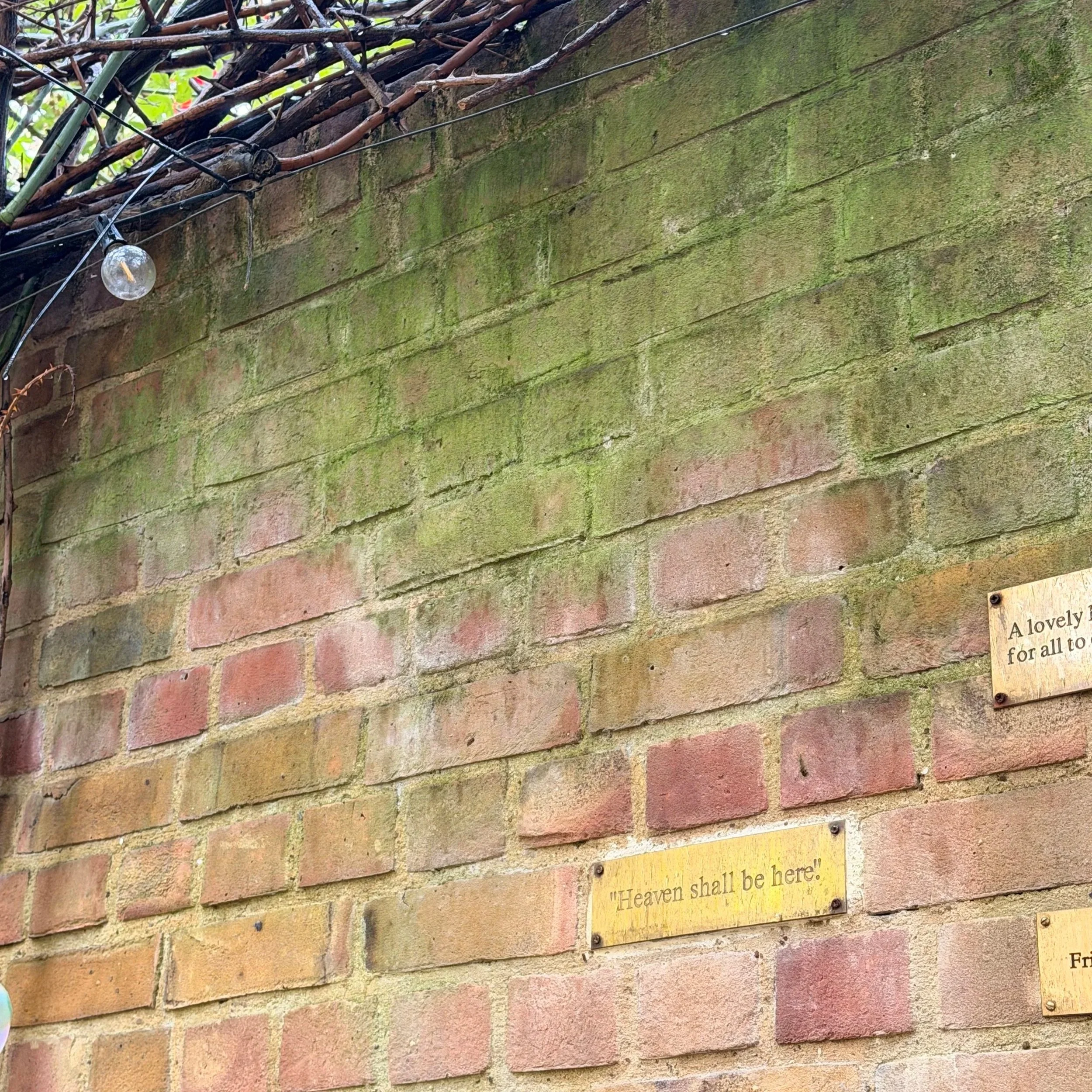
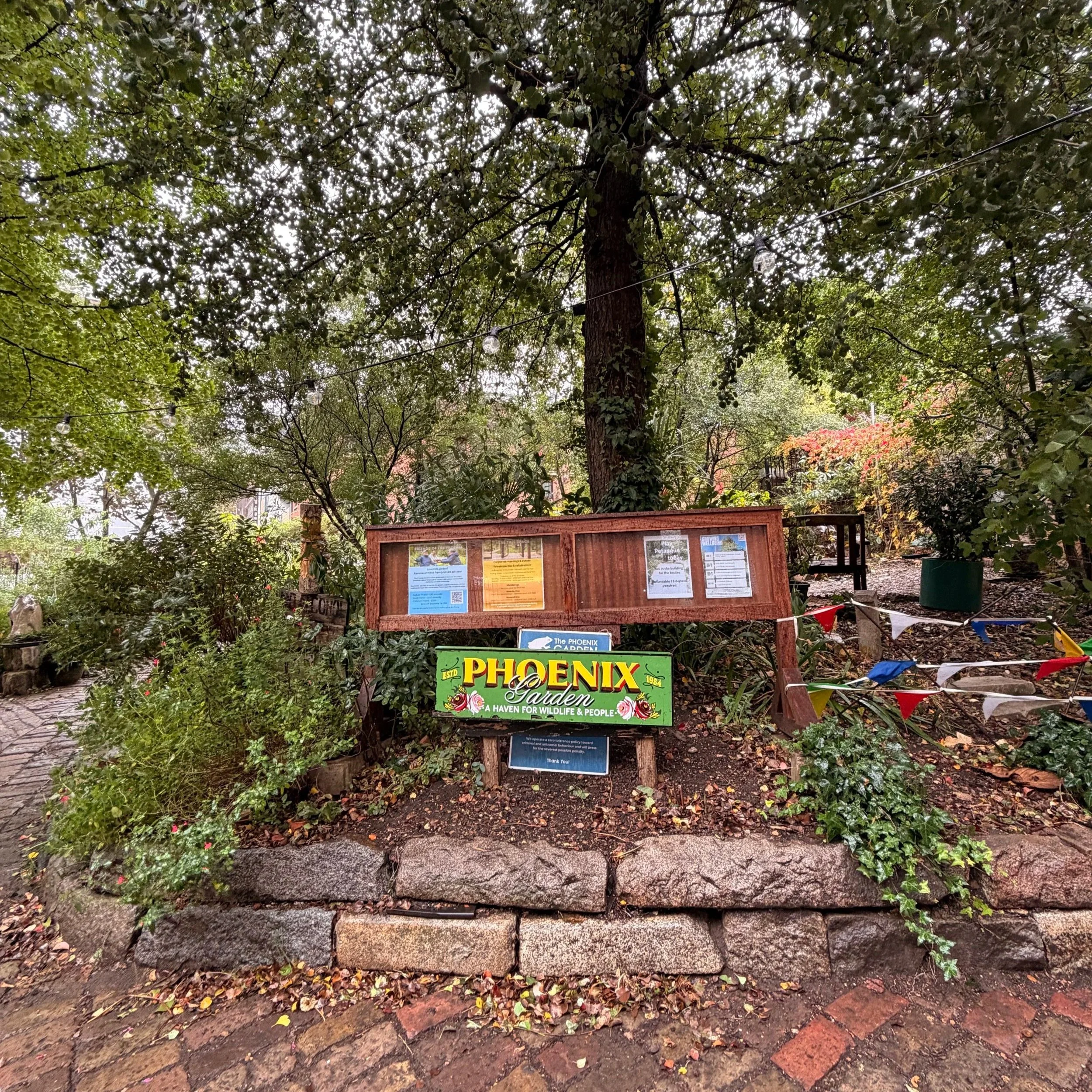
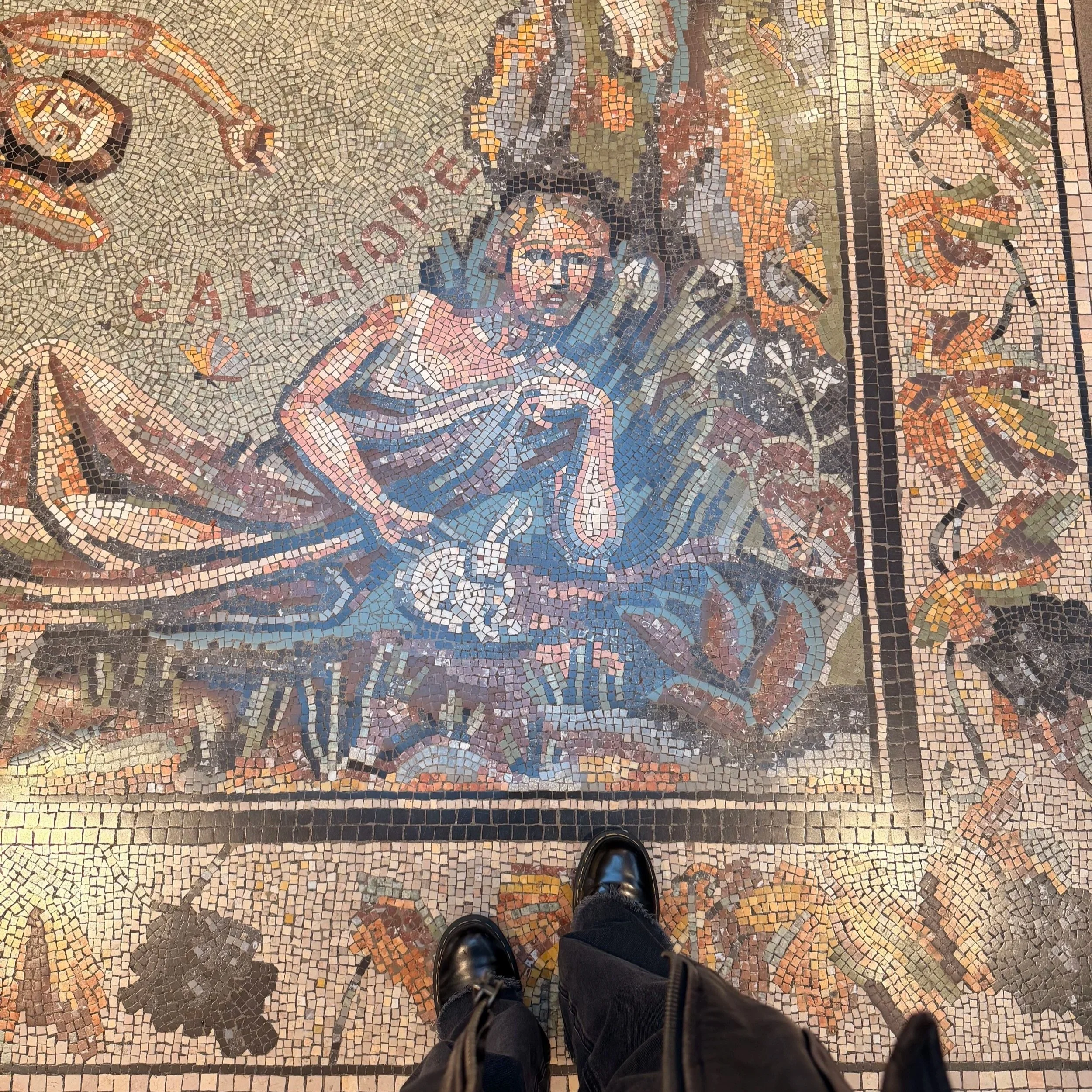
I’ll end on a lighter note with some pictures of my trip to London. I had the opportunity to see Patti Smith in conversation with Dua Lipa at the London Literature Festival, where she shared her advice to aspiring writers: “If you want to be a writer, write. And write every day.” Still on a high from seeing her, I went to visit Patti’s favorite London garden, which she mentions on ‘M Train’. “Heaven shall be here”, a metal sign on a brick wall says, and my artist heart is full of hope for the Peaceable Kingdom she speaks of. Finally, as I left The National Gallery, a mosaic of Calliope was the synchronicity to close my trip with a golden key. The muse of poetry quite literally on my path - most definitely a sign of good fortune.
