The Vatican’s Dragons and Dangerous Goddesses
When visiting the Vatican last month, our guide said “I’m a historian, so our tour today is based on history, not religion - and history is based on facts; it’s black or white”. As a non-religious history lover who equally loves fantasy, spirituality, aliens, magic and a healthy dose of conspiracy theories, his phrase hit me like an invitation to a banquet. I stepped into the museum licking my lips and wielding my imaginary cutlery like weapons, ready to pick his so-called-facts apart. Whether it’s religion, claiming their version of god as absolute, or history, organizing “facts” into a version of the story that suits the dominant group - humanity’s obsession with owning The Truth is very funny to me.
My expectations were completely shattered when I realized that the headquarters of the largest and wealthiest religion in the world actually is a collection of a plurality of stories. While it refers to the bible as its single source of truth, it houses several cultures’ versions of their truth - which, sadly, have been systematically destroyed in religious wars and discarded as mythological “untruths”. The word “myth” is known today as “a widely held but false belief or idea”, but its original meaning was “a traditional story, especially one concerning the early history of a people or explaining a natural or social phenomenon”. Just like the bible and other religious texts, mythological stories also include divine beings, heroes, villains, good, evil and other universal symbols and themes that manifest across different societies.
On one side: angels, demons, saints, evil talking snakes, rivers that turn to blood, and bushes that burn unconsumed. On the other side: goddesses and gods, dragons, sirens, phoenixes, people that are turned into animals and women that turn their enemies into stone. Miracles, or the overcoming of what was thought to be impossible, are present in both religion and mythology, with God/gods/goddesses helping figures like Moses part the seas for his people to pass and giving Hercules and Psyche the insight needed to complete their insurmountable tasks. So why is it that from a religious perspective, one is deemed as The Truth and the other is dismissed as a fantastical tale? And from a historical perspective, The Truth is that all of it is to be taken figuratively?
Both history and religion were recorded and passed on by those who had the power to do so at the time; conversely, any ideas that threatened their structures of power were discredited and destroyed. And yet, mythological stories resisted and survived in the collective unconscious. They still live in our dreams and across cultures. Dragons, for example, are present in tales all around the world - from the classic story of Saint George’s dragon in Christian mythology, to the Norse Nidhogg, Greek Typhons, Chinese Tianlong, Shenlong, and Zhulong (just to name a few) and even the one that appears in the bible fighting archangel Michael in the Book of Revelation. Even now, they are still part of modern popular culture, seen in Game Of Thrones (2011), Sleeping Beauty (1959), and The Priory of the Orange Tree (2019). And despite humanity’s clear obsession with dragons, most perspectives - religious, historical, scientific or otherwise - would agree that they aren’t real. But if they exist in the collective unconscious, doesn’t that entitle them to a place in The Truth too?
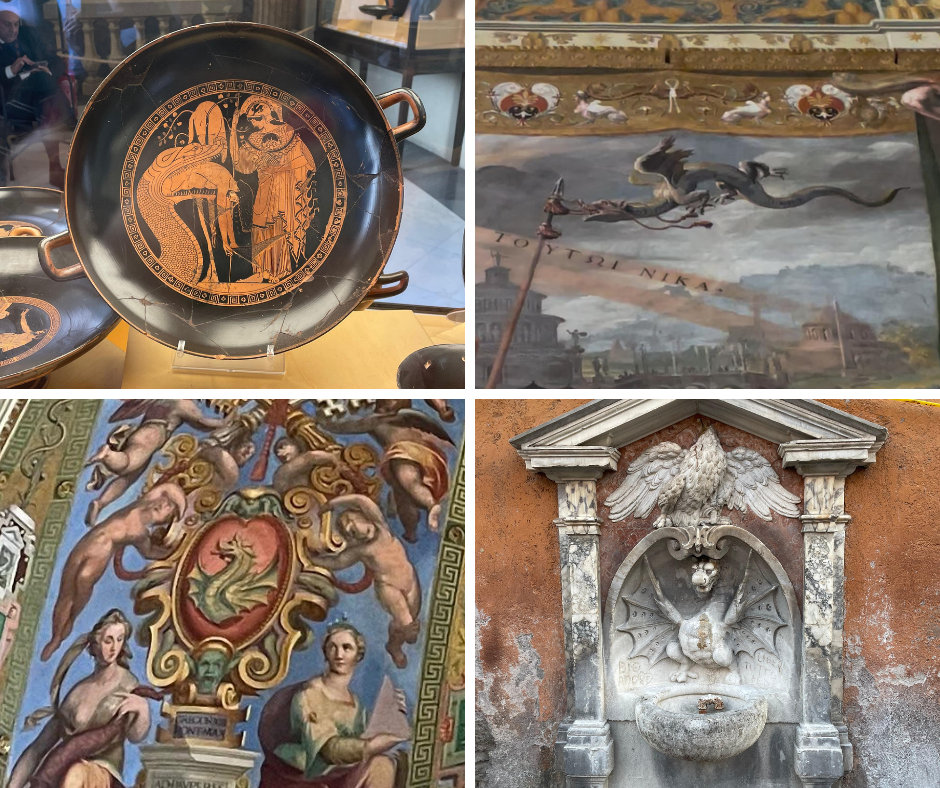
Pictures taken during my visit to the Vatican. Top left image shows a Greek plate with a dragon swallowing Jason; top right image shows a painting with a dragon flying over a battle scene; bottom left image shows an emblem with a dragon at its center; bottom right image is a stone fountain with a dragon engraved, outside the Vatican.
As the tour guide carried on broadcasting his “historical facts” into our audio receivers, I decided to lower my weapons and let my eyes wander. Instead of battling his version of The Truth, I went in search of everything that felt too dangerous or fantastical to be included in the mainstream tour. Besides dragons - and there were many of them - fantastical creatures like sphinxes, angels, winged skeletons and countless grotesque sculptures and paintings decorated every room of the museum.
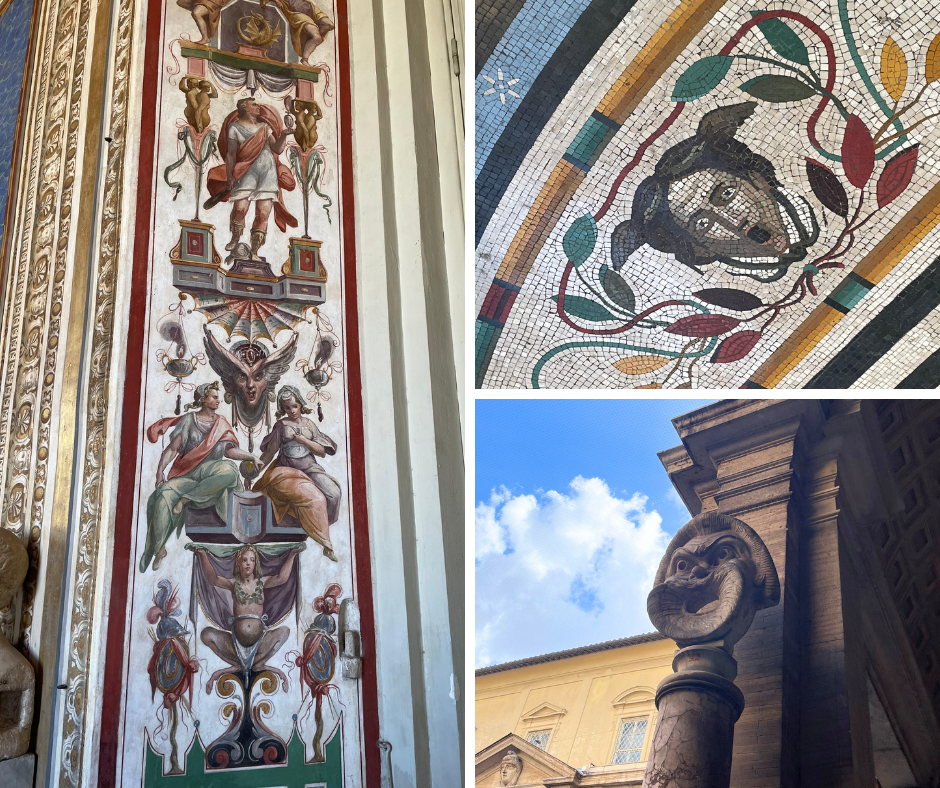
Pictures taken during my visit to the Vatican. The image on the left shows a pillar with a series of grotesque motifs painted over it in one of the halls in the Vatican; second image on the top right shows a grotesque mosaic of a screaming face; third image on the bottom right shows a grotesque sculpture of a mask.
Speaking of grotesques - Giorgio Vasari, art historian, defined them as “a type of extremely licentious and absurd painting done by the ancients ... without any logic, so that a weight is attached to a thin thread which could not support it, a horse is given legs made of leaves, a man has crane's legs, with countless other impossible absurdities; and the bizarrer the painter's imagination, the higher he was rated". What if in some version of The Truth, they actually made complete sense, but their meaning was lost in our interpretation?
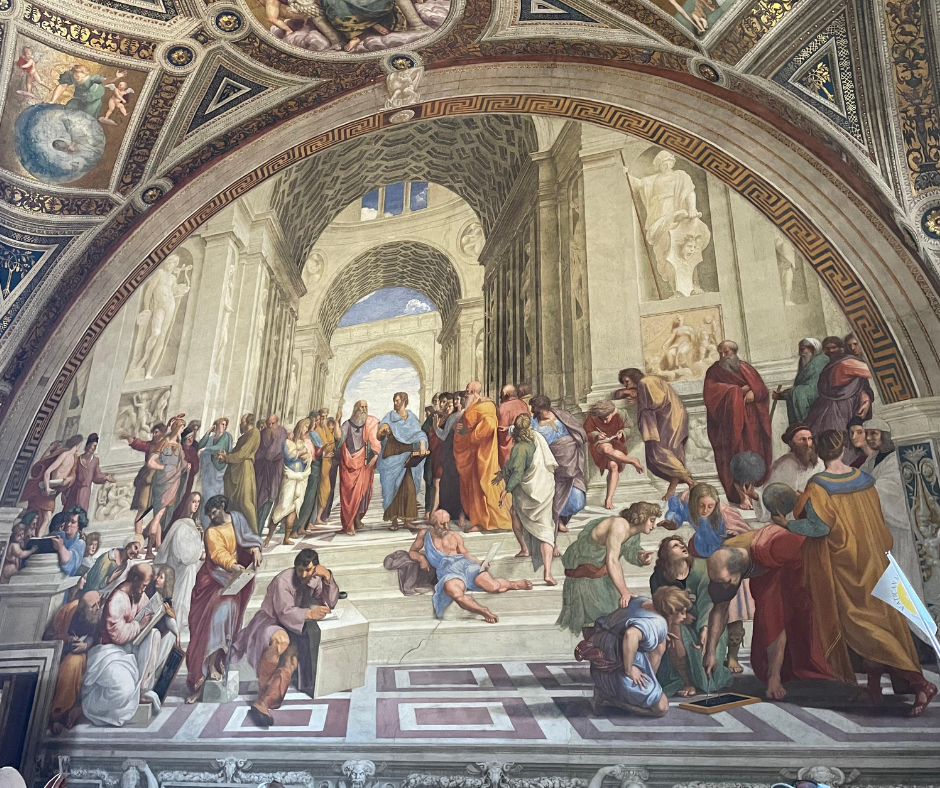
“The School of Athens” by Raphael, taken during my visit to the Vatican.
And speaking of a painter’s imagination, the Vatican houses one of the cheekiest pieces in art history, which I would dare call one of the earliest memes: “The School of Athens”, a painting by Raphael where he painted himself and his friends as sort of “easter eggs” instead of the ancient philosophers it’s supposed to depict, with rumors of Michelangelo being included there as a provocation due to a feud between the two. So if we use paintings as historical “evidence” of what we constructed to be The Truth about our ancestors, what is The Truth that will be decided about us when future generations begin to study memes? Will they get the meaning of “This is fine” right, or will they believe we actually roasted our pet dogs alive?
By the time my feet were hurting and the overstimulation from being confined in a crowded space kicked in, we came upon one of my favorite pieces in the entire visit - a sculpture of Artemis that looks very different than how she is usually portrayed. She is placed facing her classic depiction - a huntress accompanied by a dog. The unusual version that caught my eye, however, has what appears to be hundreds of egg-shaped objects hanging over her chest.
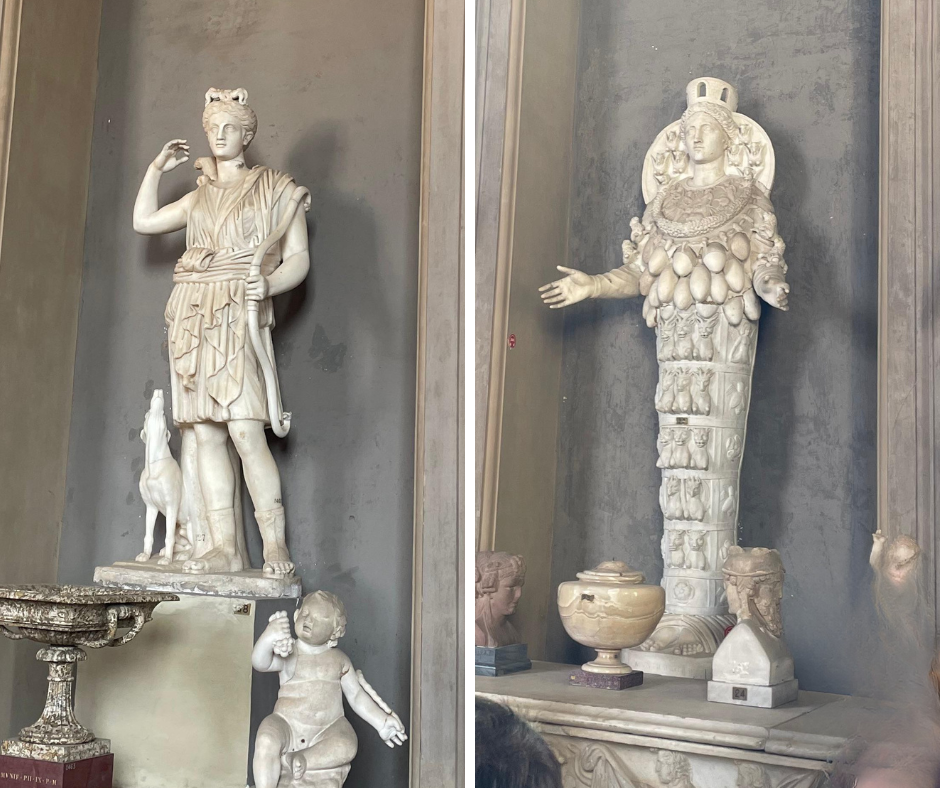
Pictures taken during my visit to the Vatican. Left: Artemis in her classic depiction. Right: the unusual Artemis that caught my attention.
The tour guide explained that they are bull testicles, emphasizing her role as goddess of fertility. Of course (insert eye-roll here). While gods each have their own distinct set of light and dark attributes, goddesses and women deities feel blurry, all sharing some kind of connection to the mother archetype and the light feminine: nurturing, beautiful, creative, compassionate, life-giving. But Artemis is the goddess of wilderness, and as such, her powerful dark feminine energy is undeniable. Once, she was said to be bathing naked in a river with her nymphs, when she caught a man spying on them. As punishment for his disrespect, she transformed him into a deer and he was then eaten by his own hunting dogs. She was said to bring immediate death with her arrows to anyone who harmed the forests she protects. Her Roman equivalent is called Diana - the name that was chosen for Wonder Woman. So maybe the testicles hanging over her chest aren’t a symbol of fertility - but a very explicit warning sign for all men who disrespect her or the wilderness she guards.
But what does that matter, if either version of her story is still categorized as “mythology” and therefore discredited from The Truth? It matters because outside the confines of religion, history or whatever other perspective claims to own The Truth, Story lives on in its own right in the collective unconscious. Artemis and Wonder Woman help people of all gender identities redefine what femininity means to them, and embrace its light and dark aspects both. The grotesque live in all of our minds wearing different masks and taking unique shapes and forms - symbolizing our shadows and the bizarre parts of ourselves that both frighten and fascinate us. Regardless of our relationship to religion or spirituality, God/ gods/ goddesses remain present in all that which human logic fails to explain - coincidences, synchronicities, miracles, or whatever you feel more comfortable calling them. And even the Vatican, with its own version of The Truth, is humbled before the power of the Stories that came before - Stories that were too powerful to kill, and which now brazenly decorate the walls of the largest religious museum in the world. Sure, they are still belittled as myth, as fantasy - but they live on beyond those walls, within every single one of us. Inexplicable, untamable and immortal.
